For a car service leaving a marketplace

Own the bookings Uber used to take.

A small limo company had been filling its calendar through Uber. That was easy, and it was expensive: Uber kept a share of every fare, and the next booking still belonged to Uber. As the company grew, they wanted software they owned. Passengers should book themselves. The owner should run the day from a phone. New trips should arrive as a normal phone notification, in Telegram, rather than inside another app.

Why it was built

Keep the customer, and keep the fee Uber was taking.

A marketplace app will take a booking at 11 p.m. without anyone answering the phone. The cost is the cut, and the fact that the passenger's next trip still starts in Uber. This company wanted that self-serve convenience on a stack they controlled. Driver is the three pieces they asked for: an AI chat so passengers can book themselves, a phone app (a PWA they install from the browser) so the owner can manage the day, and Telegram so a new trip shows up as a native phone notification.

Book

Booking chat

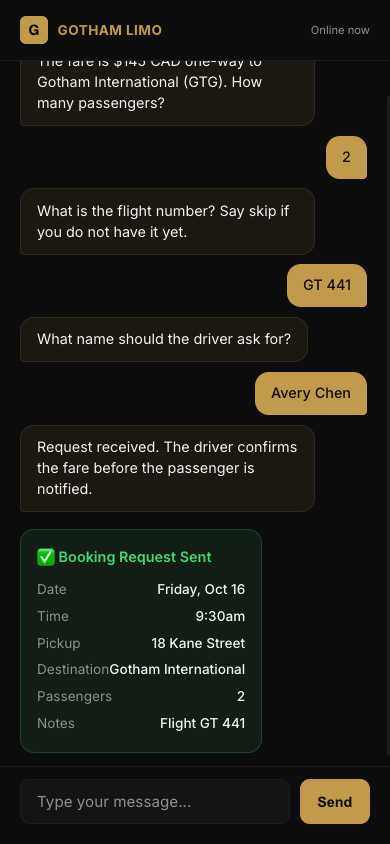
This replaces the Uber request. A passenger books on the company's own site, including after hours, without calling. The chat asks for a street or a landmark, checks hours and service area, and either quotes a published fare or says a driver will.

  • A city name alone is not enough
  • Quiet hours and service area
  • Flight number on airport trips

Try an example →

Ops

Driver app

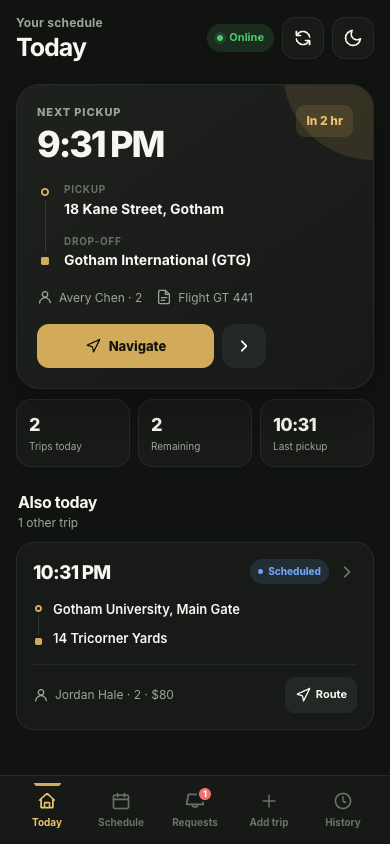
This replaces Uber's driver app. It is a PWA: a site the owner adds to the phone's home screen, with no app-store release. They set the fare, read the booking chat, confirm the ride, and write the invoice.

  • Final fare before approve
  • Telegram can suggest; the portal confirms
  • Incomplete chats and funnel analytics

See the portal →

Alerts

Telegram

This is the notification, not another login to remember. Telegram already reaches a phone the way a text does, which matters when someone is between trips. New requests, reminders, and ride status go only to drivers on the list.

  • Today, upcoming, and pending
  • Set price, then approve or decline
  • Morning summary and pickup reminders

See Telegram →
Booking chat

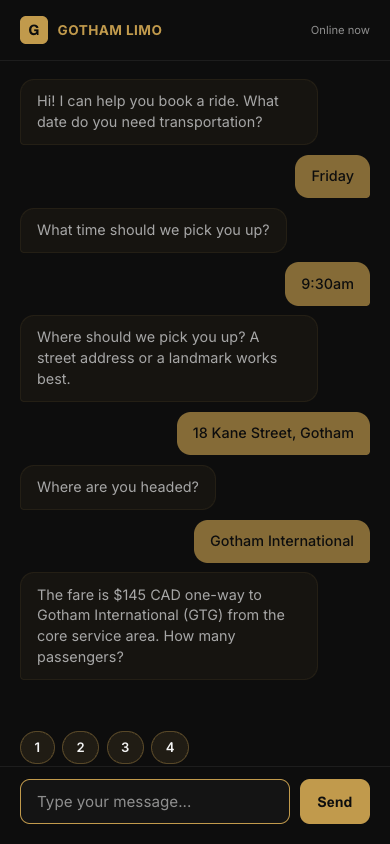
Passengers book themselves, without opening Uber.

The chat is the self-serve desk. It collects the trip the way a dispatcher would, then leaves a request the driver can accept, with the conversation still attached. The example on this site uses Toronto streets so you can try that path. It does not book a car.

  • Published fare for a named route, single number
  • Driver quote when the trip is not on the card
  • Passenger can revise a pending request in the same thread
  • Unfinished chats stay on the request for the driver

Try the exampleBooking chat details

Phone app

Run the day from the home screen, not from Uber.

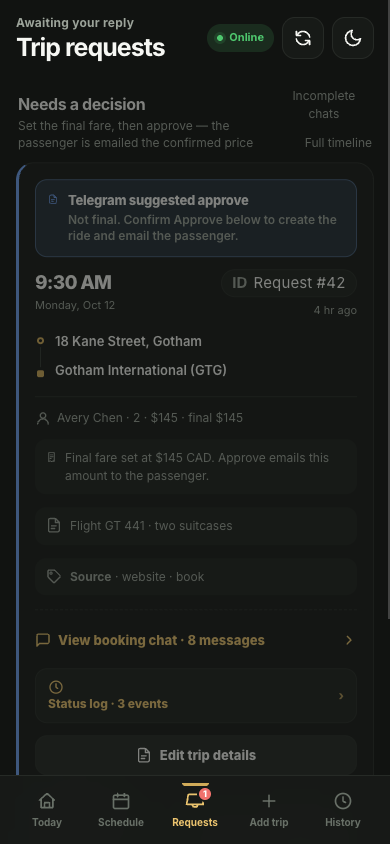
The PWA is where the owner manages what used to live in someone else's driver app. Add it to the home screen, sign in with a PIN, and the day's trips, pending requests, and invoices are there. Telegram can suggest approve or decline. The phone app is where the fare is confirmed and the passenger is emailed that amount, not the chat's estimate.

  • Today, with the next pickup and the rest of the day
  • Final fare required before approve
  • Booking transcript on the request
  • Incomplete chats, status log, and funnel analytics

See the portal

Telegram bot

A new trip should feel like a text, not a new app.

They did not want to build a notification system, or ask a driver to remember to open one. Telegram already sends a phone alert the moment a message arrives. New bookings and pickup reminders go there. People who are not on the driver list get no reply. Invoices and adding a trip by hand stay in the phone app, because those are forms, not a tap.

  • Only listed driver chats can reply
  • Set the fare, then approve or decline
  • Complete, no-show, or cancel from the chat
  • 15- and 5-minute pickup reminders

See Telegram

The public site

The company's name on the booking, not Uber's.

The marketing site is how a passenger finds this company instead of opening a marketplace app. Services, the vehicle, and airports sit next to the same booking chat, on a domain the company owns. A visit can become a request without a callback, and without Uber taking the introduction.

Gotham Limo services section on marketing site
Gotham Limo airports section on marketing site

The customer site →

Telegram and the phone app

The alert and the office share one ride.

Telegram is how a driver hears about a trip while they are out. The phone app is where they confirm the fare, read the chat, and finish the paperwork. Both are looking at the same request.

CapabilityTelegramDriver portal
Booking alertsNative pushOpen the portal
Approve / decline + set fareSuggests, or binds if you turn confirm offBinding confirm
Read the booking chat—Yes, on the request
Payment methodOn completeAnytime
Today & upcomingYesYes
Complete / no-show / cancelYesYes
DirectionsYesYes
Manual add trip—Yes
Incomplete chats & analytics—Yes
InvoicesLink outFull form + print URL
Trip history & coupons—Yes
AuthChat allowlistPIN → 24h session
Who it is for

An owner who still drives, or a small fleet that just hired.

This started with one limo company that had outgrown "just use Uber" and did not want an enterprise dispatch system. It fits that owner, and a few drivers who need one shared queue as the company adds people.

One owner-driver

Bookings still come in after hours, through the chat, instead of through Uber. The home-screen app is the office. Telegram is for the trip that cannot wait until they park.

A small fleet

Several drivers can sit on the Telegram list and see the same pending queue. Fares stay consistent, and invoice history is there for repeat accounts.

This stack, under your name. Or a different one.

Driver is what we built so that company could leave Uber's marketplace without going back to a phone that never stopped ringing. If you want it under your name, write to us. If you want Cedar Labs to build the equivalent for a different business, that is the same conversation.

hello@cdr.xyz